Wednesday, 16 June 2010

The new Ginza?


I am blogging on my birthday. Recently I have been going to Ginza at least once a month, for kimono events etc. Ginza has a reputation as being one of the most expensive places in Tokyo. I never used to go there, unless I had a visitor from abroad, because you need a mortgage to buy a cup of coffee. But since the 1980s, with the downturn in the economy, I think Ginza has been reinventing itself. Ginza reinvented itself after the great Kanto earthquake, the resulting fires from which burnt down much of Tokyo. At that time it was rebuilt in concrete and steel, and the first department stores were born in Japan. A cafe culture also grew up at that time, and women moved into the work force in large numbers, as secretaries, "office ladies", and waitresses. As women were able to move out of the home and into the workplace, they also had money to spend and could go shopping or watch movies. At that time, Ginza represented something modernistic and progressive, but over the years, this has become an area of tradition and history. Although the department stores originally had a democratizing role in fashion, Ginza became the area of the rich. My image has been that rather wealthy businessmen's rather rich wives could shop here. Increasingly though, the original department stores have been having a hard time, and with their images of high prices, and catering to the wealthy and not so young, have seen falling sales in recent years.
However, I notice many changes in Ginza. Yes, it is still the land of designer brands, but often in their own stores, rather than in the department stores. Apple opened its flagship store here, a five or six story glass box, and recently Abercrombie and Fitch have opened up a jean store. On entering, I was not sure if it was a shop or a club, with black shiny floors, floor lighting and reflective images everywhere. Their staff gyrate for you, great you in English and a godlike young Japanese man, of the "ikemen" type, wearing nothing but a pair of low, low, did I say low? rise jeans and his smooth copper suntan will stand near the entrance and take photos with screaming girls, lining up. The homo-erotic images are overt. This is as much a play land as a jeans shop. I felt quite disoriented, but I have passed too many birthdays to be able to think with this kind of music on, or see in this kind of lighting. (I am not sure where the clothes were hiding.) Not only fashionable stores aimed at the young, but stores known for their low prices have also appeared. Uniqlo obviously sells enough stuff to make up for its low priced fast fashion, and my students tell me that Forever 21 has a bigger store here than in Harajuku. Cool hunters are snapping away at the weekends, when the streets are closed to traffic, and Ginza seems to be attracting a younger crowd. Anything can happen, and I have no explanation for the man who chose to make his bed in the middle of the road, where he was carefully negotiated around, by curious shoppers, but not disturbed. Some Japanese can sleep anywhere! Pictures taken on various Saturday afternoons!

Wednesday, 9 June 2010

A lucky find!


There are many little junk shops and shops which recycle things which are no longer of use in people's homes. Often they sell women's clothes, various miscellaneous dishes and odd ornaments or antiques. There is one near my house which opened up a couple of years ago. It is rather fun to browse through these bits of discarded materiality which must have been cluttering up someone's house. Sometimes I am looking for something practical, like a large salad bowl, which is an ongoing project, but other times I am just sort of cruising, and waiting for a meeting with something inspiring.
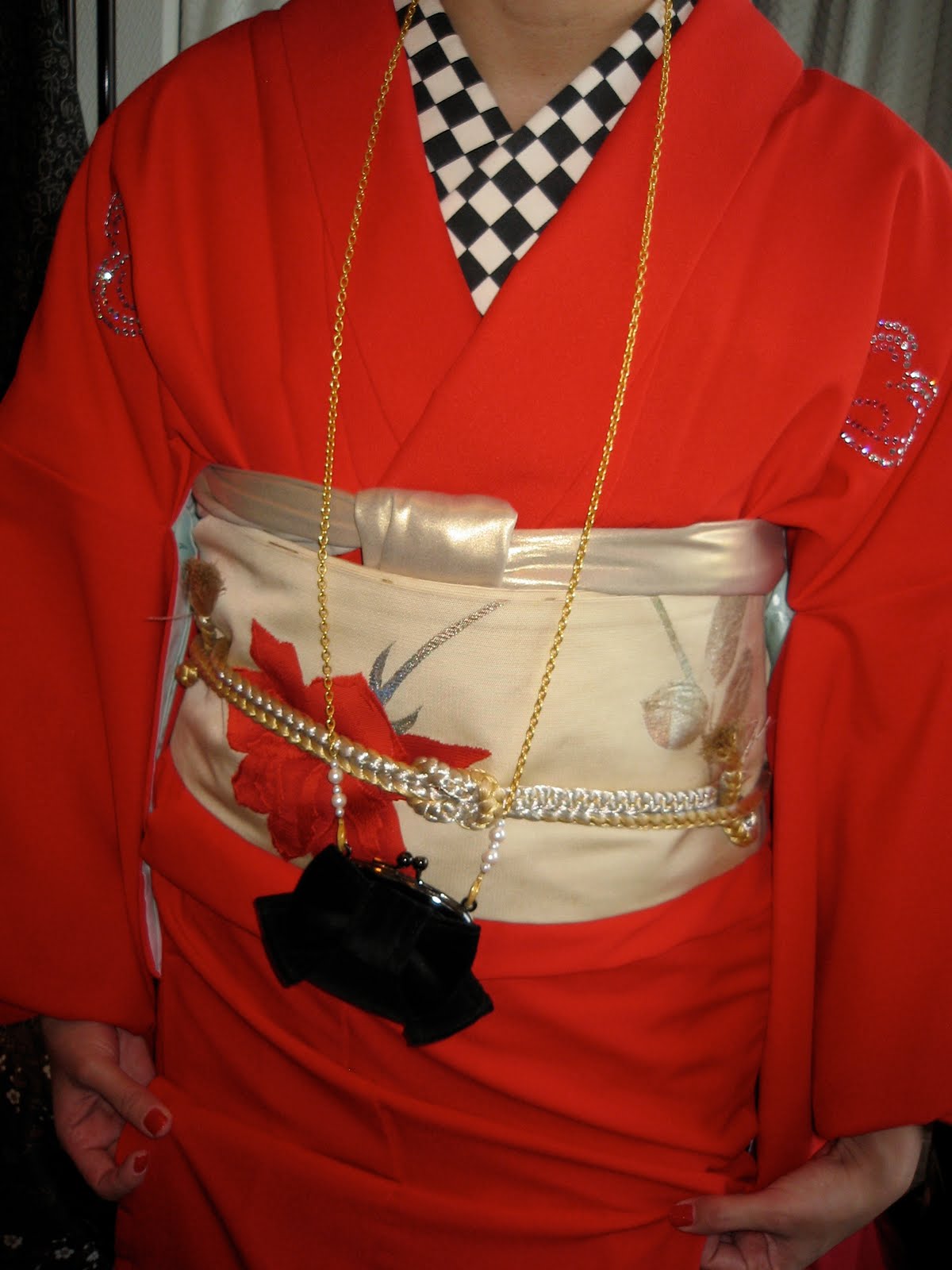
I have been hoping to find some embroidered collars for kimono underwear, for some time. New ones with substantial embroidery, (which is machine done), start from about 6,000 yen, which is an investment. I might find a nice kimono for the same money. So I never have managed to find many good ones. In Ginza's antique mall, they have old ones, hand embroidered from the taisho or showa periods, which cost as much, or more, than the new ones. In the taisho period they were a particularly important accessory, and people lined up outside the department stores to buy the new, most fashionable collars. Indeed, they invested more in the collar than in the kimono.
The store near my house has a few uninspiring kimono, and one or two nice accessories, all in a big pile at the back of the shop. I do not know whether the owner is interested in kimono or not, (possibly not), but in this pile I saw a traditional nagajuuban, (petticoat) dyed in momi (safflower), which had tie dyed circles on it, and an attractive woven ground. I already have several of these underwears, so I was not intending to buy it, until I noticed the collar on it. It was a beautiful piece of embroidery, hand done, with celebratory motifs on it. I asked how much she wanted for it, and I was happy to buy it for 1,500 yen. She was selling the underwear, but I was buying the collar. I thought I would possibly sell on the underwear itself. Then, when I got home, I found something else lovely about this underwear. The sleeves are lined with red and white stencilled momi, which was popular from the meiji period. Probably this had been another underwear, which had fallen apart and was used in the construction of this one. All in all it turned out to be very interesting for all the different techniques employed in its construction, and in the history that probably goes with it. Not sure if I will really want to part with this one........

Sunday, 23 May 2010

Live folk music survives


On Saturday I was suddenly invited to go to a special pub, where live tsugaru jamisen can be heard. There is a bit of a history to the place. After the war, in the 1950s people flooded to Tokyo to find work, from poor country areas, especially in the northern part of Japan. These workers all arrived at the Ueno area of Tokyo, and there were hundreds of little bars and restaurants where they could go and hear live music from their home countryside. This little establishment is the only one of these that still survives. Apparently it is popular with sumo wrestlers, many of whom come from this area. There are two sort of folk types of music in Japan. One is enka, which is really nostalgic drinking songs, using conventional Western styled instruments. It has some similarities with country and western music, songs about lost love, drinking too much and so on. It could be considered a sort of early version of pop music. In contrast to this, minyou, is folk music, more similar to the folk songs of Ireland or Scotland, deeply rooted in a place, and played with traditional Japanese instruments. The tsugaru peninsula is in the very north part of Honshu island, and is famous for its harsh climate, and its shamisen players. The area is also where the famous writer, Osamu Dazai came from. It is a wild and beautiful place, far from the bustle of Tokyo, and consequently from the economic advantages found in a big city. I wonder if poverty and folk music have an inverse relationship, as the musical heritage is rich. These young guys and gals were also our waiters at the low flat tables and several of them are winners of the national tsugaru jamisen contests. Interestingly enough two of them come from Kyushu, the other end of Japan!
Their clothing is typical work pants, called momohiki, and happi jackets. These are seen in the country and in festivals throughout Japan. The indigo and white is beautiful in its simplicity and their performance was stunning in its energy. Enjoy!

Monday, 17 May 2010

Guys' Kimono


Recently I think that men's kimono is making a bit of a comeback. I have to admit that I think Japanese guys look much cooler in kimono than they do in suits. Suits seem to make everyone look the same, and are dull and boring. Actually, the kimono fabrics for men are not very colourful either. I wish they were more colourful. They are beginning to be more interesting though. Some of the pictures here show items that are home made, such as the bag with the skeletons, and also the interesting woven bag with the square hole in the top, for a fan. That guy actually made it out of a kind of fishing cage. It was attached to a rope before, and was used to keep fish that were caught. He took off the rope and added handles. I thought that was a very original and interesting idea. Some of his accessories are wonderful too. The white cotton yukata, that looks like an Edo period design, is very interesting too. If you look very closely, you can see surfers in the waves! He's to men who dress snappy! I want to see more of it.

Kurofune Matsuri


The festival of black ships takes place in Shimoda and commemorates the arrival of ships from America, at the end of the Edo period, and is significant in that it was the beginning of Japan renewing official with relations with the outside world, which in turn led to the modernization and development which took place in the Meiji period. The matsuri is a large event, which happens in the center of the little town and included a kimono fashion show, in the beautiful grounds of a temple under the mountains, and a big parade through the city the next day. The parade is an interesting mix, with Okinawan drummers, Brazilian samba dancers, and traditionally dressed samurai, geisha, ninja, oiran and all sorts. There is plenty of music, too, with American military bands, Dixie groups, shamisen and taiko. The stores all open up food stands on the street and there is much eating, drinking and celebrating going on. It was nice to see whole families watching the parade go by, grandparents and little kids, everyone out of their houses. In spite of Japanese being known as generally shy, they do have events like this, where the community pulls together. Such events don't have a counterpart in the UK, I don't think, so it is a great thing to see. In spite of all the drinking, you do not see people behaving badly, or making a nuisance of themselves, and people take the time to stop and talk to people they do not know. I think this is the kind of thing I think is really special in Japan.
We spent the night in a Japanese style inn and of course, we enjoyed karaoke, an onsen bath, and ate good seafood for dinner.
The Okinawan dancers have bingata kimono, and you might notice that they have osode, and also no hashiori, presumably because of the climate. Their hats are lotus flowers. The oiran's outfit is very gorgeous, with a small triangle on the collar turned over, which is supposedly erotic. The American's costumes are 19th century naval ones. There is a mad here in Edo period traveller's costume. He is actually travelling around Japan in this outfit, with his whole family! There were some interesting looking people in Shimoda yesterday!

Thursday, 13 May 2010

Asian Studies Conference Japan


In mid June, I will be giving a presentation at The Asian Studies Conference Japan. I have put together a panel of four people, who can speak about issues related to Japanese fashion. Toby Slade, who has recently published, "Japanese Fashion, a cultural history", Elizabeth Kramer, who researches on the way that Victorians introduced bits of Japanese textiles and designs into their fashion, in England, Michael Furmanovsky, who writes about Japanese popular and country music, and I, will be presenting. The reader will be Yuniya Kawamura, from the Fashion Institute of Technology in New York. She researches about aspects of Japanese street style. Whilst Toby Slade and Elizabeth Kramer will be speaking about more historical issues, Michael Furmanovsky and I will be discussing more contemporary ones. I am very excited and nervous about this conference, and today I have been preparing my power point presentation. My theme is how kimono is changing in Japan, now. I will be talking about new businesses and also about the way kimono interacts with technology, namely, the internet.
Looking back, when I arrived in Japan, the only way to learn kimono was to go to the kimono school. When I wanted a yukata, I went and chose a roll of cloth and I was measured, and waited three weeks to go and get it. Everything was made to measure. All the accessories at the kimono school had to be white. Other colours were rarely seen. People thought that kimono was just a hobby for rich housewives, along with ikebana and English conversation. It sort of gave you cultural brownie points. Those pastimes were nicknamed the "marital arts". If a girl could do those things she could find a desirable husband.
Even whilst Dalby was writing that kimono was not going to change any more and was a fixed system, I could see that things were beginning to change. I began to see new kimono books on the shelves and I noticed that coloured tabi had arrived in the shops. Now there are not only coloured, but patterned, lace, and made to order tabi. Then you wore zori or zori, but now geta are popular too, and even boots are coming in for casual wear. Kimono were silk or silk, but now they are silk, cotton, polyester or wool. Then we used white collars but now we use embroidered or coloured ones, or cut our own from old kimono. Creativity has returned, and kimono schools will have a hard time surviving, when people can learn to dress from Youtube, in America or Amsterdam. Kimono is being democratized like it was in the Edo period, when Japanese were fashion crazy, and like the Taisho period, when girls were collar crazy! Here's to democracy. I am all for a bit rule breaking, in an appropriate situation!

Saturday, 8 May 2010

Starting Summer


Summer starts in the world of wafuku, kimono, on June 1st. It matters not what whimsy the weather is involved with, it starts on June 1st. After the coldest April for 41 years, including a decent snowfall after the cherry blossoms, we are suddenly up in the high 20s (centigrade) after only one week of May. It is time for koromogai. This means the packing away of the winter wardrobe and the airing of the summer one. For most of us, when its up near 30 degrees, a lined kimono, with lined underwear, (that makes 4 layers, and 8 at the front where everything is double), not to mention the under underwear, and the obi and all its accompanying accessories, is a little too much like a sauna for comfort. So from June 1st, we may wear an unlined kimono with unlined underwear. The silk may be thinner, too. Sha and akashi silk are two examples, though a fine crepe is also good. For July and August, ro, sha, cotton or linen may be worn. Many women, prefering to bend the rules a little rather than ruin their kimono with sweat, don summer wear sometime in May. This makes good sense because even summer kimono is hot. Japanese summer makes one want to remove layers, as much as possible.

The art of summer kimono is about faking cool. One should look cool as a cucumber, in order to make the people around you feel cool. It is no good boiling and steaming, with a bright red face and trickles on your neck. You literally have to play it cool, fake it, for your fellows. Because of this logic the designs and colours on summer kimono tend to be muted, even dull. Small wild flowers, wading or sea birds, fish and waves or flowing water are frequent motifs, designed for the cool you. Though a plum or pink might be seen, a bright red summer kimono I have never encountered.

Here are a selection from my collection. A wading stork on an antique black ro, and sea birds on a woven kimono from Okinawa. Vines and lilies on antique kimono, both ro, and iris on a cotton yukata. There are two obi, one pale blue with squares of summer flowers, and an antique one which is reversible black and white, with cartwheels in a swamp. Can they trick the gazer into a cool oasis?