Showing posts with label fashion. Show all posts

Saturday, 14 August 2010

Talking of obi...


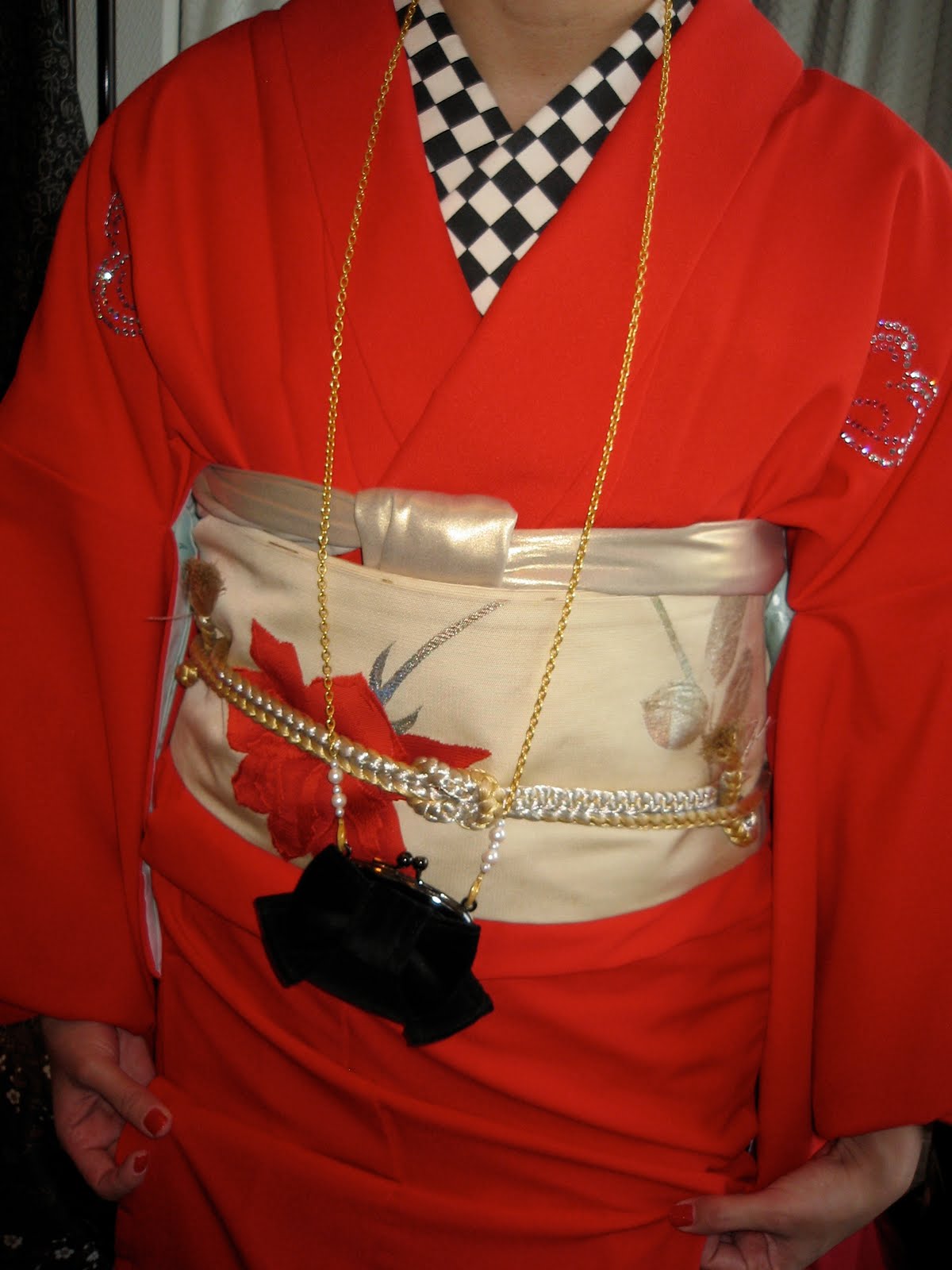
I was asked, by a facebook kimono fan, to write about obi. It is a perfect chance to photograph and post some of my favourites, but also write a bit about obi too. Originally just a narrow hidden tie, that held the kimono in place, the obi has become as important as the kimono itself. It would be unthinkable to go out without some sort of obi on. The obi should match the kimono in value. To pair up an expensive kimono with a cheap obi, is to carry a Louis Vuitton bag and a 100 yen plastic umbrella together. Even in the last 100 years though, obi have been changing and are continuing to change. Before the taisho period, (1920s) they were generally much softer and a reversible one, called a kujira obi was popular. It was usually black or grey and then bright on the other side, (like the under and upper sides of a whale, hence the name.) Then a chuya obi became popular. There are a few in my photographs. They are soft and reversible, not good for tying otaiko, but for big floppy eared ribbons, they are very nice. Another obi which has gone out of regular use is the maruobi. There are two photographed here. They were woven on a loom double the width of an obi, and then it was folded in half. They are hugely heavy and thick, and usually shorter than today's fukuro obi, so are not very versatile for tying fancy knots.
Today, there are three types in regular use. For full formal wear a fukuro obi is required. Usually it is woven in nishijin ori, which has silver and gold threads in it. It can also be tsuzure, finger-nail tapestry weaving, or possibly be dyed by a yuzen artist. Embroidered ones are also popular. The fukuro obi is 4 metres and 10cm long. Unlike a maru obi, it is not an extra wide weaving folded in half, but is usually backed with some plain cloth. It also often has a facing put inside to increase the stability, but you may choose not to have this, if you are tying fancy bows. Some have a repeating design down all but the center section, and some have a design in only one point. The one point ones are for tying nijuudaiko, the double drum bow, required for married women on formal occasions. If you have a design on most of the obi, then you can tie nijuudaiko or fancy bows.
Far less restricting, and easier to tie is the nagoya obi, which is the regular obi for everyday use. According to the fabric it is more or less formal, but basically it is shorter and often sewn in half down about half of its length. It is usually about 3.5 to 4 meters long. The older ones tend to be shorter and are therefore a little difficult to get a good big taiko out of. Some nagoya have designs down the length, and others are one point designs. If you have a one point design, you must be sure that it shows in the correct place, when you make a taiko. You can also make ogidaiko, tsuno dashi or ginza musubi, (non of which I am very good at), and I have also tied one into a big ribbon at the front, and then swizzled it round to the back. Yes, its possible!
The third kind of obi, is the han haba, or kofukuro obi. It is basically a half width obi, and is about 3m 60cm long, though there are longer ones for parties, and shorter wool ones for summer yukata. They can be tied in numerous ways, the most common ones being bunko and kai no kuchi.
Choosing your obi can be difficult. They say to have three obi for each kimono. As a very rough guideline, a woven obi with silver and gold in it, can not be worn with a woven kimono, only with a more formal dyed kimono, (including komon, iro muji, homongi and tomesode.) A kimono which is woven, wool, tsumugi etc, must be worn with an obi that is woven with plain threads or a dyed obi. You can up and down the formality with accessories too. If you look at the half width obi photograph you can see that they are all different types and many are cut down from other obi. If they are gorgeous weaving, they can be used for a party on dyed kimono. Adding an obi jime and obi age will increase the formality. Some designs also belong to certain seasons, too. Here are grapes, (end of summer) maples (autumn) cranes (new year and celebrations) etc. Also it is important how you pair the kimono and obi together. Exactly the same design is considered boring and unoriginal. A related design, is cool. If not by design then colour, a lighter or darker shade, a contrasting shade or picking up one colour from the kimono usually works well. If you are not sure, then go for the safe option. I still ask a lot of advice from older kimono wearers.

Tuesday, 20 July 2010

Fun Footwear


I have had a strange month with the loss of my father, and also another important person in my life history. Hence I have not been writing for a while. Recently I have been interested in feet, and I am not sure why, but mine are particularly awful looking according to children and end up being the butt?? of many jokes. I protest that they are beautiful, and I love them, (we go back a long way), but the truth of the matter is that they are better covered up.
Another truth is, well, I have a bit of a shoe addiction. I love shoes of interesting colours, and designs, and used to wear one green and one pink clog together, as I don't agree that they should have to be the same. Who made that rule? Why does everyone stick to it? I have a friend whose father always wears different coloured socks, and think it is wonderful.
I confess to having bought shoes that don't fit, just because they look wonderful, and have just kept them in the cupboard. Everybody knows how a good looking shoe (or two) can lift one's mood and make one's day brighter. I think my own collection is quite interesting, but Japanese footwear is also pretty interesting. The really high geta, as worn by oiran entertainers are beautifully lacquered and so seem to have more in common with a piece of table wear than with regular footwear, and the straw sandals, worn in the country side, appear to have more in common with hats, and they are actually woven together. Lacquered geta are sometimes beautifully carved too, and some have golden designs on, rather like temple decorations. Zori, leather, plastic or cloth coated footwear are the correct wear for formal occasions, and must be worn with white tabi. On other occasions colourful tabi, even lace ones have become popular, but geisha from the Fukugawa area of Tokyo are famous for their beautiful feet, and show them off in summer and winter, by never wearing any tabi at all.
I once went and had a pair of geta made for me in Asakusa. It was such fun to choose the bases and the ties, and then watch them be constructed in front of me. It gave me great satisfaction to see my choices coming together into a pair of geta, specially for me. They are my most comfortable geta, and I love to wear them even when I am not wearing kimono.
Well I am posting a random collection which I have photographed around Tokyo, both yo and wa styles. And I give a special mention to Hetty Rose, who so beautifully bridges the gap between both cultures with her made to measure footwear using recycled materials, most importantly kimono fabric. Look at her website, for more inspiring designs. http://www.hettyrose.co.uk/They will blow you away! Amazingly beautiful. So here's to feet, walking with us, the whole of our lives. Together every step of the way. They are undeservedly ignored. Enjoy the photographs.

Wednesday, 16 June 2010

The new Ginza?


I am blogging on my birthday. Recently I have been going to Ginza at least once a month, for kimono events etc. Ginza has a reputation as being one of the most expensive places in Tokyo. I never used to go there, unless I had a visitor from abroad, because you need a mortgage to buy a cup of coffee. But since the 1980s, with the downturn in the economy, I think Ginza has been reinventing itself. Ginza reinvented itself after the great Kanto earthquake, the resulting fires from which burnt down much of Tokyo. At that time it was rebuilt in concrete and steel, and the first department stores were born in Japan. A cafe culture also grew up at that time, and women moved into the work force in large numbers, as secretaries, "office ladies", and waitresses. As women were able to move out of the home and into the workplace, they also had money to spend and could go shopping or watch movies. At that time, Ginza represented something modernistic and progressive, but over the years, this has become an area of tradition and history. Although the department stores originally had a democratizing role in fashion, Ginza became the area of the rich. My image has been that rather wealthy businessmen's rather rich wives could shop here. Increasingly though, the original department stores have been having a hard time, and with their images of high prices, and catering to the wealthy and not so young, have seen falling sales in recent years.
However, I notice many changes in Ginza. Yes, it is still the land of designer brands, but often in their own stores, rather than in the department stores. Apple opened its flagship store here, a five or six story glass box, and recently Abercrombie and Fitch have opened up a jean store. On entering, I was not sure if it was a shop or a club, with black shiny floors, floor lighting and reflective images everywhere. Their staff gyrate for you, great you in English and a godlike young Japanese man, of the "ikemen" type, wearing nothing but a pair of low, low, did I say low? rise jeans and his smooth copper suntan will stand near the entrance and take photos with screaming girls, lining up. The homo-erotic images are overt. This is as much a play land as a jeans shop. I felt quite disoriented, but I have passed too many birthdays to be able to think with this kind of music on, or see in this kind of lighting. (I am not sure where the clothes were hiding.) Not only fashionable stores aimed at the young, but stores known for their low prices have also appeared. Uniqlo obviously sells enough stuff to make up for its low priced fast fashion, and my students tell me that Forever 21 has a bigger store here than in Harajuku. Cool hunters are snapping away at the weekends, when the streets are closed to traffic, and Ginza seems to be attracting a younger crowd. Anything can happen, and I have no explanation for the man who chose to make his bed in the middle of the road, where he was carefully negotiated around, by curious shoppers, but not disturbed. Some Japanese can sleep anywhere! Pictures taken on various Saturday afternoons!

Thursday, 13 May 2010

Asian Studies Conference Japan


In mid June, I will be giving a presentation at The Asian Studies Conference Japan. I have put together a panel of four people, who can speak about issues related to Japanese fashion. Toby Slade, who has recently published, "Japanese Fashion, a cultural history", Elizabeth Kramer, who researches on the way that Victorians introduced bits of Japanese textiles and designs into their fashion, in England, Michael Furmanovsky, who writes about Japanese popular and country music, and I, will be presenting. The reader will be Yuniya Kawamura, from the Fashion Institute of Technology in New York. She researches about aspects of Japanese street style. Whilst Toby Slade and Elizabeth Kramer will be speaking about more historical issues, Michael Furmanovsky and I will be discussing more contemporary ones. I am very excited and nervous about this conference, and today I have been preparing my power point presentation. My theme is how kimono is changing in Japan, now. I will be talking about new businesses and also about the way kimono interacts with technology, namely, the internet.
Looking back, when I arrived in Japan, the only way to learn kimono was to go to the kimono school. When I wanted a yukata, I went and chose a roll of cloth and I was measured, and waited three weeks to go and get it. Everything was made to measure. All the accessories at the kimono school had to be white. Other colours were rarely seen. People thought that kimono was just a hobby for rich housewives, along with ikebana and English conversation. It sort of gave you cultural brownie points. Those pastimes were nicknamed the "marital arts". If a girl could do those things she could find a desirable husband.
Even whilst Dalby was writing that kimono was not going to change any more and was a fixed system, I could see that things were beginning to change. I began to see new kimono books on the shelves and I noticed that coloured tabi had arrived in the shops. Now there are not only coloured, but patterned, lace, and made to order tabi. Then you wore zori or zori, but now geta are popular too, and even boots are coming in for casual wear. Kimono were silk or silk, but now they are silk, cotton, polyester or wool. Then we used white collars but now we use embroidered or coloured ones, or cut our own from old kimono. Creativity has returned, and kimono schools will have a hard time surviving, when people can learn to dress from Youtube, in America or Amsterdam. Kimono is being democratized like it was in the Edo period, when Japanese were fashion crazy, and like the Taisho period, when girls were collar crazy! Here's to democracy. I am all for a bit rule breaking, in an appropriate situation!