Showing posts with label kimono. Show all posts

Sunday, 6 February 2011

Traditional kimono makers


Traditional kimono makers, who have gone through the traditional apprenticeship and all the traditional training, are, I suppose, a dying breed. There are not many people now, who want to devote their life to an art where the financial rewards are probably meagre, and the work time consuming, repetitive, lonely and not always much fun.

I first met SK when we were both submitting work for an exhibition. I wasn't sure where to go, and she helped me. I do dyeing as a hobby, but SK works as a weaver. She graduated from a fashion school and then apprenticed herself to a craftsman weaver in Nagano, rather than to a famous name in Tokyo. She worked for him for several years, for board and lodging, and her work included delivering threads and orders to farmers' wives, and later picking up the finished woven bolts. She also had time to work on her own, first plain and then striped bolts. When I met her she was living near Tokyo, but then she decided to move to Shizuoka, and she built a house with a studio, where she has lived since. She visits Tokyo for occasional exhibitions.

What I admire about SK is the fact that she starts at the very beginning, growing the plants and extracting the dyes to make her work. She also does a fantastic job of egasuri, picture ikat, of traditional Japanese motifs. They are always sensitive and delicate works, that take an enormous amount of time, sometimes several months, for one kimono. Since I met her she has won several awards for her work, and has had it presented in national exhibitions. She remains unwired and growing, dyeing and weaving her beautiful art.

NS I met completely by accident. I was wearing a kimono in a restaurant and he was staring at me. He gave his name card to the restaurant owner, who then passed it on, saying that if I liked kimono I should go and visit his studio. Of course, I called him the next day, and we have been friends for over 20 years.

He came from the countryside in north Japan, and when he graduated high school, he got on a train for Tokyo the next day, almost never to go back. Through family connections he was apprenticed to Arai Terutaro, a famous Tokyo Yuzen dyer. At first he ran errands for a lot of the time. He was the bottom of the pile and there were several more advanced apprentices. However, he was precociously brilliant at the drawing and tracing work, that is a part of the essential yuzen dyer's training. In his 20s and 30s he was getting to be a leading light and had a show at the famous Hotel Okura. He had commissions from well-connected people in the political and also in the geisha world. He was doing well and then suddenly he got sick. He was hospitalized for a long time, and disappeared from public life.

When I saw his yuzen, I thought it was the most beautiful yuzen I had ever seen. He does not need to embellish with gold lines or much embroidery. His use of colours and shading are superb. I have never seen any yuzen like his on sale in shops or even at kimono sales. He refuses to enter any national exhibitions, and just wants to concentrate on his art. However, with funding from the Japan Foundation, I managed to pursuade him to come and teach a workshop on yuzen to fashion students at Manchester Metropolitan University. It was a major operation to make him a passport and a bank account, and to take him away from Tokyo, on a major journey and look after him for three weeks. The workshop was a great success.

Through NS I met FC. She is also a weaver, in Tokyo, who has a workshop and about ten apprentices who work for her. She too grows and dyes the threads herself, and also has a small indigo pot, in the garden. I spent a pleasant afternoon with her, and we all tried on many different kimono lengths, to see the effect. The cloth has double warps and wefts which makes the complex kind of squared or checked effect.

FC has her two daughters working for her, and all the other apprentices to support, so she is more concerned with making contacts and marketing her work. She seems to be actively involved in neighborhood events.

After we made a huge mess, trying on lots of her roles of cloth, she got out some snacks and beer, and we were further treated with beautiful foods and tastes after feasting our eyes on her lovely work.

Monday, 3 January 2011

Kitsuke


I am sorry for not having written on my blog for so long. I have been working on my PhD and also on keeping up posts on the kimono facebook page, which I think is going from strength to strength. I am going to write about the art of kitsuke, kimono dressing.
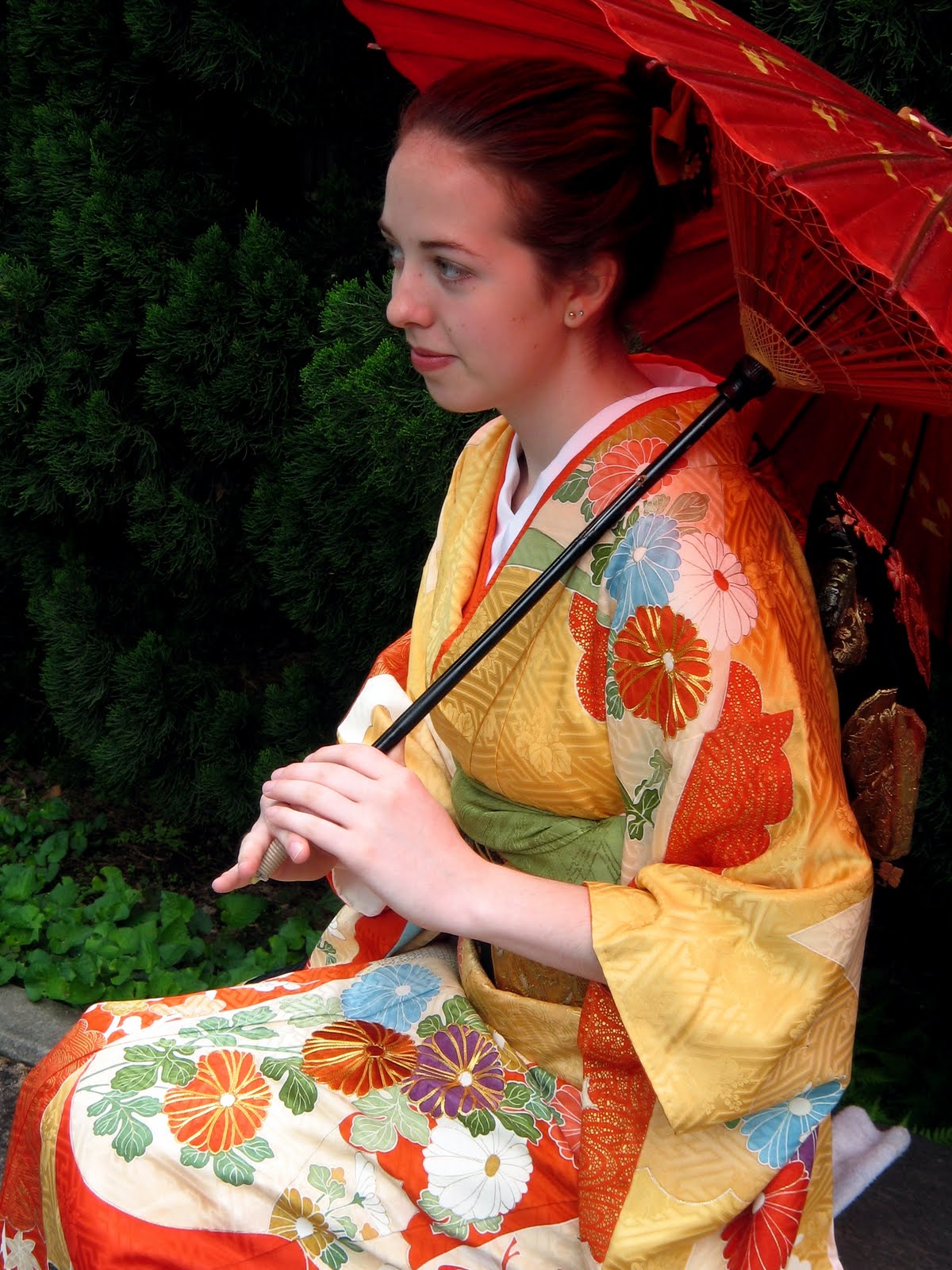
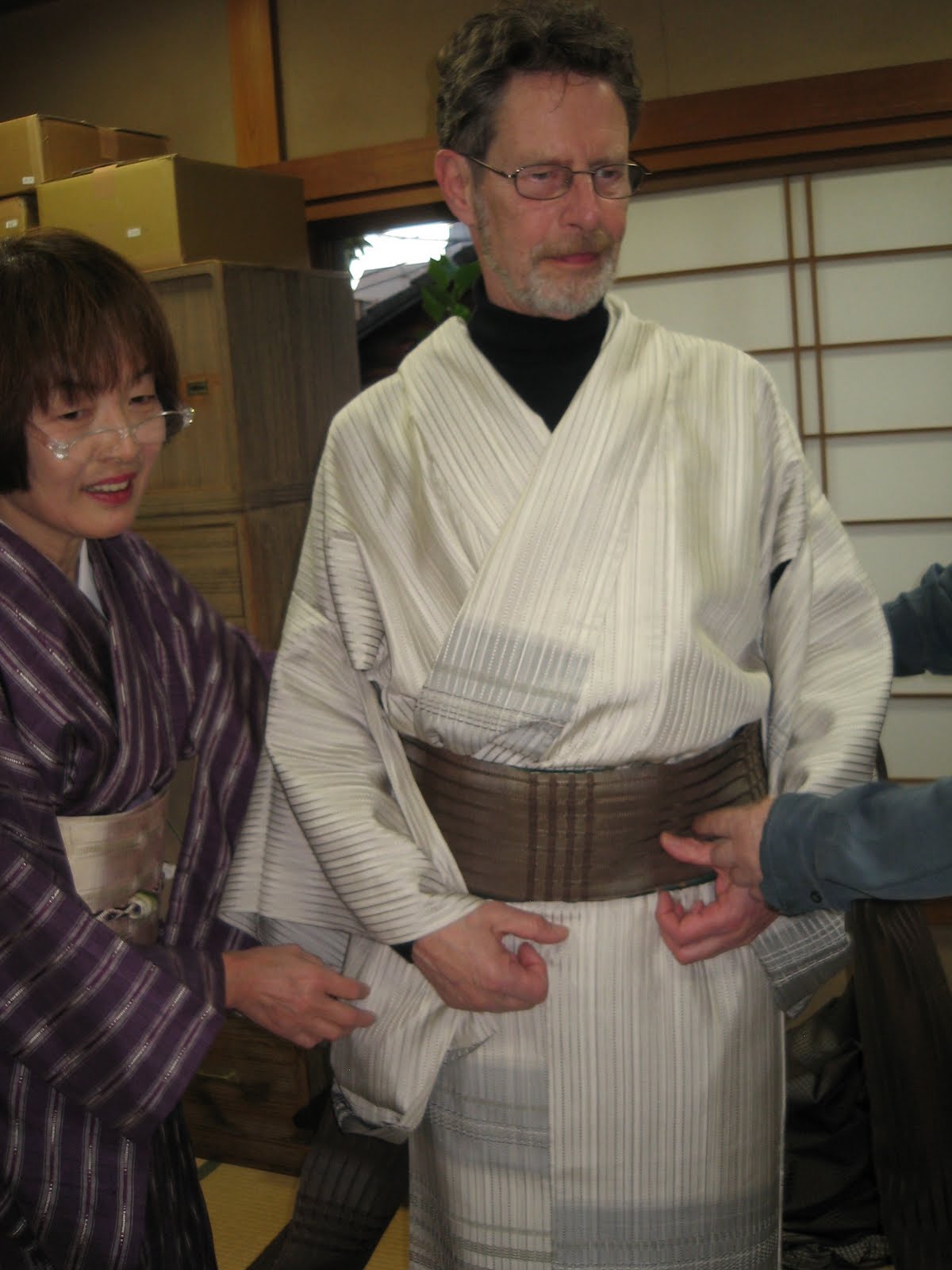
I started learning kitsuke in a kitsuke school, almost before I could speak Japanese, so I learnt the language and the kitsuke together, really. There were about ten girls in the class and I was the only one who seemed to need to ask questions, but my teachers were patient with this strange foreigner and appreciated my desire to learn how to do it all properly. At first I thought I would just learn to dress myself, but then I wanted more and more, and I ended up staying in classes for two years and becoming qualified as a kitsuke dresser and teacher, after taking a written and practical exam. I teach kitsuke in my university, just the basics, but one of the most fun things I do, as a little part time job, is to dress people. I have dressed all kinds of ages, nationalities and shapes of people, and it is fantastic because we always have such fun, and they love being turned into a prince or princess and wearing all that silk. Mainly I dress non-Japanese, but occasionally Japanese people also ask me to dress them. I dress visitors to Japan, families, children for shichi, go, san, and high school girls for graduation, and also twenty year olds, for seijin shiki, (coming of age) in Japan. It is always a challenge because often I dress people who are taller or larger than Japanese, and I want to make them all look great. I help them to choose all the separate parts of the outfit and then we also have fun choosing interesting locations for the photographs. I usually lend them the kimono set and also take photographs and put them on a CD. It is fun to get to know people this way, and I think it is a privilege to be able to dress them and give them these CDs.

Saturday, 14 August 2010

Talking of obi...


I was asked, by a facebook kimono fan, to write about obi. It is a perfect chance to photograph and post some of my favourites, but also write a bit about obi too. Originally just a narrow hidden tie, that held the kimono in place, the obi has become as important as the kimono itself. It would be unthinkable to go out without some sort of obi on. The obi should match the kimono in value. To pair up an expensive kimono with a cheap obi, is to carry a Louis Vuitton bag and a 100 yen plastic umbrella together. Even in the last 100 years though, obi have been changing and are continuing to change. Before the taisho period, (1920s) they were generally much softer and a reversible one, called a kujira obi was popular. It was usually black or grey and then bright on the other side, (like the under and upper sides of a whale, hence the name.) Then a chuya obi became popular. There are a few in my photographs. They are soft and reversible, not good for tying otaiko, but for big floppy eared ribbons, they are very nice. Another obi which has gone out of regular use is the maruobi. There are two photographed here. They were woven on a loom double the width of an obi, and then it was folded in half. They are hugely heavy and thick, and usually shorter than today's fukuro obi, so are not very versatile for tying fancy knots.
Today, there are three types in regular use. For full formal wear a fukuro obi is required. Usually it is woven in nishijin ori, which has silver and gold threads in it. It can also be tsuzure, finger-nail tapestry weaving, or possibly be dyed by a yuzen artist. Embroidered ones are also popular. The fukuro obi is 4 metres and 10cm long. Unlike a maru obi, it is not an extra wide weaving folded in half, but is usually backed with some plain cloth. It also often has a facing put inside to increase the stability, but you may choose not to have this, if you are tying fancy bows. Some have a repeating design down all but the center section, and some have a design in only one point. The one point ones are for tying nijuudaiko, the double drum bow, required for married women on formal occasions. If you have a design on most of the obi, then you can tie nijuudaiko or fancy bows.
Far less restricting, and easier to tie is the nagoya obi, which is the regular obi for everyday use. According to the fabric it is more or less formal, but basically it is shorter and often sewn in half down about half of its length. It is usually about 3.5 to 4 meters long. The older ones tend to be shorter and are therefore a little difficult to get a good big taiko out of. Some nagoya have designs down the length, and others are one point designs. If you have a one point design, you must be sure that it shows in the correct place, when you make a taiko. You can also make ogidaiko, tsuno dashi or ginza musubi, (non of which I am very good at), and I have also tied one into a big ribbon at the front, and then swizzled it round to the back. Yes, its possible!
The third kind of obi, is the han haba, or kofukuro obi. It is basically a half width obi, and is about 3m 60cm long, though there are longer ones for parties, and shorter wool ones for summer yukata. They can be tied in numerous ways, the most common ones being bunko and kai no kuchi.
Choosing your obi can be difficult. They say to have three obi for each kimono. As a very rough guideline, a woven obi with silver and gold in it, can not be worn with a woven kimono, only with a more formal dyed kimono, (including komon, iro muji, homongi and tomesode.) A kimono which is woven, wool, tsumugi etc, must be worn with an obi that is woven with plain threads or a dyed obi. You can up and down the formality with accessories too. If you look at the half width obi photograph you can see that they are all different types and many are cut down from other obi. If they are gorgeous weaving, they can be used for a party on dyed kimono. Adding an obi jime and obi age will increase the formality. Some designs also belong to certain seasons, too. Here are grapes, (end of summer) maples (autumn) cranes (new year and celebrations) etc. Also it is important how you pair the kimono and obi together. Exactly the same design is considered boring and unoriginal. A related design, is cool. If not by design then colour, a lighter or darker shade, a contrasting shade or picking up one colour from the kimono usually works well. If you are not sure, then go for the safe option. I still ask a lot of advice from older kimono wearers.

Sunday, 23 May 2010

Live folk music survives


On Saturday I was suddenly invited to go to a special pub, where live tsugaru jamisen can be heard. There is a bit of a history to the place. After the war, in the 1950s people flooded to Tokyo to find work, from poor country areas, especially in the northern part of Japan. These workers all arrived at the Ueno area of Tokyo, and there were hundreds of little bars and restaurants where they could go and hear live music from their home countryside. This little establishment is the only one of these that still survives. Apparently it is popular with sumo wrestlers, many of whom come from this area. There are two sort of folk types of music in Japan. One is enka, which is really nostalgic drinking songs, using conventional Western styled instruments. It has some similarities with country and western music, songs about lost love, drinking too much and so on. It could be considered a sort of early version of pop music. In contrast to this, minyou, is folk music, more similar to the folk songs of Ireland or Scotland, deeply rooted in a place, and played with traditional Japanese instruments. The tsugaru peninsula is in the very north part of Honshu island, and is famous for its harsh climate, and its shamisen players. The area is also where the famous writer, Osamu Dazai came from. It is a wild and beautiful place, far from the bustle of Tokyo, and consequently from the economic advantages found in a big city. I wonder if poverty and folk music have an inverse relationship, as the musical heritage is rich. These young guys and gals were also our waiters at the low flat tables and several of them are winners of the national tsugaru jamisen contests. Interestingly enough two of them come from Kyushu, the other end of Japan!
Their clothing is typical work pants, called momohiki, and happi jackets. These are seen in the country and in festivals throughout Japan. The indigo and white is beautiful in its simplicity and their performance was stunning in its energy. Enjoy!